
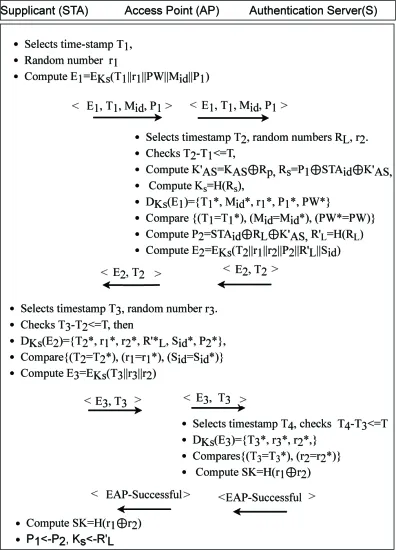
The growing usage of wireless devices has significantly increased the need for Wireless Local Area Network (WLAN) during the past two decades. However, security (most notably authentication) remains a major roadblock to WLAN adoption. Several authentication protocols exist for verifying a supplicant’s identity who attempts to connect his wireless device to an access point (AP) of an organization’s WLAN. Many of these protocols use the Extensible Authentication Protocol (EAP) framework. These protocols are either vulnerable to attacks such as violation of perfect forward secrecy, replay attack, synchronization attack, privileged insider attack, and identity theft or require high computational and communication costs. In this paper, a lightweight EAP-based authentication protocol for IEEE 802.11 WLAN is proposed that not only addresses the security issues in the existing WLAN authentication protocols but is also cost-effective. The security of the proposed protocol is verified using BAN logic and the Scyther tool. Our analysis shows that the proposed protocol is safe against all the above attacks and attacks defined in RFC-4017. A comparison of the computational and communication costs of the proposed protocol with other existing state-of-the-art protocols shows that the proposed protocol is lightweight than existing solutions.